Original research by CarsMultiverse · Published 17 July 2026 · Data: July 2026
Driving electric is cheaper than petrol in all 36 countries we analysed — but where you live changes the prize enormously. A typical compact EV saves its owner $17,444 in fuel costs over five years in Hong Kong, but only $2,184 in Japan. Across all 36 countries, the average five-year saving is $5,600, and driving 100 km on electricity costs on average 3.4× less than on petrol.
Key findings
- EVs win everywhere: in every one of the 36 countries analysed, charging at home is cheaper per kilometre than filling up — from 1.7× cheaper (Japan, Ireland) to 8.4× cheaper (Hong Kong).
- Hong Kong is the runaway #1: the world’s most expensive petrol ($4.06/litre) meets moderate electricity prices — $17,444 saved over 5 years.
- The Nordics and Western Europe dominate the top 10: Finland ($9,664), Norway ($8,974), the Netherlands ($8,888) and Denmark ($8,434) all pair pricey petrol with relatively affordable home charging.
- Cheapest place on Earth to charge: Malaysia, at just $0.83 per 100 km. The most expensive: Ireland at $7.57 — nine times more.
- The United States ranks only 32nd ($3,090 saved) — cheap petrol shrinks the EV advantage, even though charging is also cheap.
- Oil states still favour EVs: even with petrol under $0.65/litre, Qatar and Saudi Arabia drivers save $2,300–$2,400 over five years.
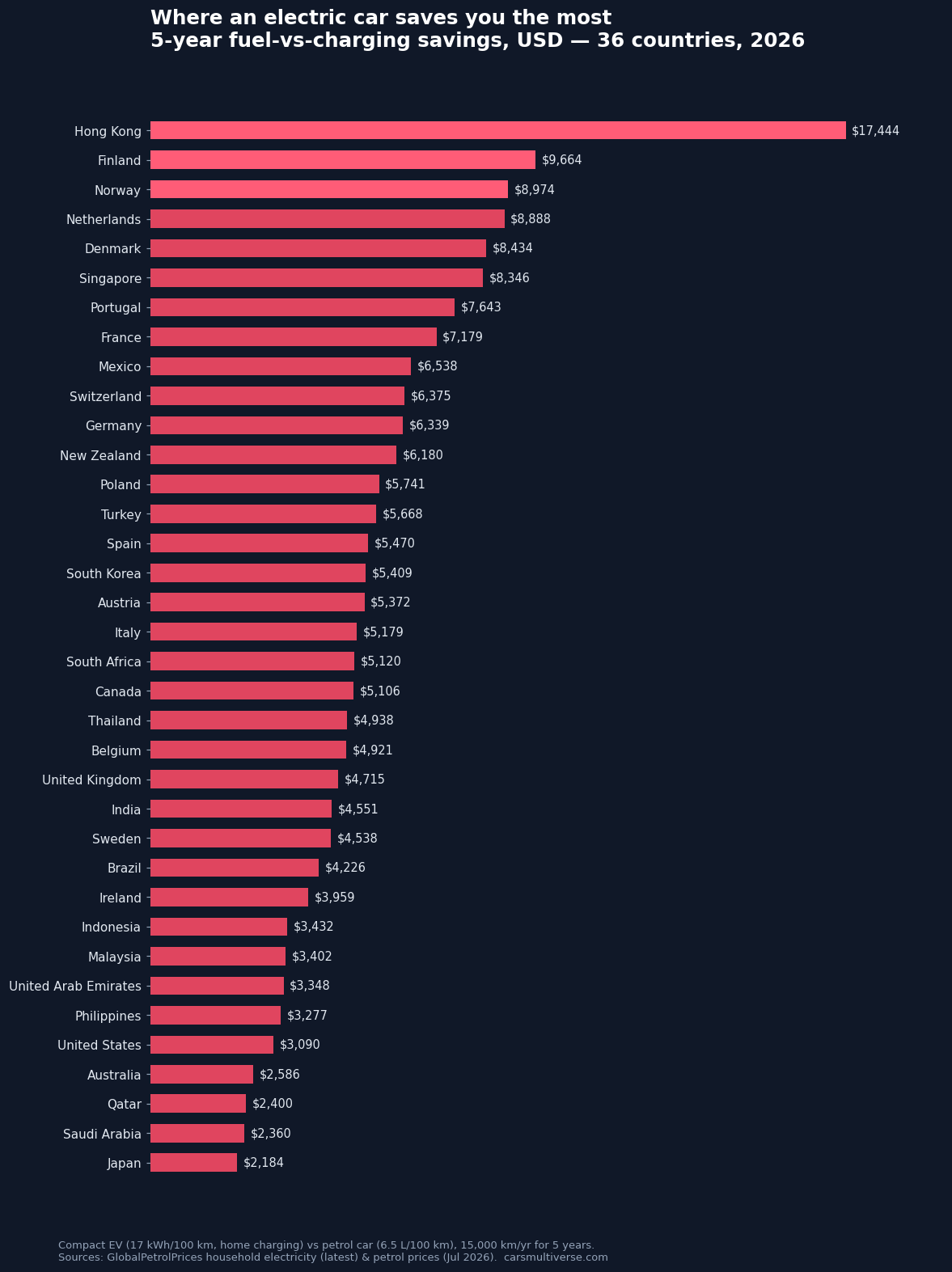
The full 2026 ranking: all 36 countries
Costs shown in USD. “Per 100 km” compares home-charging an efficient compact EV against fuelling a comparable petrol car. Savings assume 15,000 km per year over five years.
| # | Country | EV / 100 km | Petrol / 100 km | Saved / year | Saved / 5 years | Petrol ÷ EV |
|---|---|---|---|---|---|---|
| 1 | Hong Kong | $3.15 | $26.40 | $3,489 | $17,444 | 8.4× |
| 2 | Finland | $2.97 | $15.86 | $1,933 | $9,664 | 5.3× |
| 3 | Norway | $2.69 | $14.65 | $1,795 | $8,974 | 5.5× |
| 4 | Netherlands | $4.83 | $16.68 | $1,778 | $8,888 | 3.5× |
| 5 | Denmark | $6.19 | $17.43 | $1,687 | $8,434 | 2.8× |
| 6 | Singapore | $3.98 | $15.11 | $1,669 | $8,346 | 3.8× |
| 7 | Portugal | $4.01 | $14.20 | $1,529 | $7,643 | 3.5× |
| 8 | France | $4.71 | $14.28 | $1,436 | $7,179 | 3.0× |
| 9 | Mexico | $1.82 | $10.54 | $1,308 | $6,538 | 5.8× |
| 10 | Switzerland | $6.22 | $14.72 | $1,275 | $6,375 | 2.4× |
| 11 | Germany | $6.87 | $15.32 | $1,268 | $6,339 | 2.2× |
| 12 | New Zealand | $3.52 | $11.76 | $1,236 | $6,180 | 3.3× |
| 13 | Poland | $3.96 | $11.62 | $1,148 | $5,741 | 2.9× |
| 14 | Turkey | $1.14 | $8.70 | $1,134 | $5,668 | 7.6× |
| 15 | Spain | $4.25 | $11.54 | $1,094 | $5,470 | 2.7× |
| 16 | South Korea | $2.14 | $9.35 | $1,082 | $5,409 | 4.4× |
| 17 | Austria | $5.92 | $13.08 | $1,074 | $5,372 | 2.2× |
| 18 | Italy | $7.09 | $13.99 | $1,036 | $5,179 | 2.0× |
| 19 | South Africa | $3.37 | $10.19 | $1,024 | $5,120 | 3.0× |
| 20 | Canada | $2.09 | $8.90 | $1,021 | $5,106 | 4.3× |
| 21 | Thailand | $2.16 | $8.74 | $988 | $4,938 | 4.0× |
| 22 | Belgium | $6.87 | $13.43 | $984 | $4,921 | 2.0× |
| 23 | United Kingdom | $6.82 | $13.10 | $943 | $4,715 | 1.9× |
| 24 | India | $1.31 | $7.38 | $910 | $4,551 | 5.6× |
| 25 | Sweden | $4.01 | $10.06 | $908 | $4,538 | 2.5× |
| 26 | Brazil | $2.74 | $8.37 | $845 | $4,226 | 3.1× |
| 27 | Ireland | $7.57 | $12.84 | $792 | $3,959 | 1.7× |
| 28 | Indonesia | $1.55 | $6.12 | $686 | $3,432 | 4.0× |
| 29 | Malaysia | $0.83 | $5.37 | $680 | $3,402 | 6.4× |
| 30 | United Arab Emirates | $1.36 | $5.82 | $670 | $3,348 | 4.3× |
| 31 | Philippines | $3.50 | $7.87 | $655 | $3,277 | 2.2× |
| 32 | United States | $3.13 | $7.25 | $618 | $3,090 | 2.3× |
| 33 | Australia | $4.35 | $7.80 | $517 | $2,586 | 1.8× |
| 34 | Qatar | $0.54 | $3.74 | $480 | $2,400 | 6.9× |
| 35 | Saudi Arabia | $0.88 | $4.03 | $472 | $2,360 | 4.6× |
| 36 | Japan | $3.89 | $6.81 | $437 | $2,184 | 1.7× |
Download the full dataset (CSV) — free to reuse with attribution to CarsMultiverse.
Why the gap is so big
Two forces drive the ranking. The first is petrol tax policy: Hong Kong, the Netherlands, Denmark and Finland tax fuel heavily, so every litre avoided is worth more. The second is electricity prices: countries like Ireland ($0.445/kWh) and Italy ($0.417/kWh) claw back part of the EV advantage at the plug, while Malaysia, Qatar and Turkey charge next to nothing for power.
The sweet spot is expensive petrol plus cheap electricity — exactly the combination in Finland, Norway and France (helped by nuclear and hydro power). The weakest case is cheap petrol plus average electricity: Japan, Australia and the United States sit at the bottom of the table not because EVs are expensive to run there, but because petrol is comparatively cheap.
Incentives can double the win
This ranking counts only running costs — purchase incentives come on top. Italy currently offers up to €11,000 off a new EV, Poland ≈€9,440, Germany €6,000 and France €5,700, while Norway exempts EVs from VAT entirely. The US federal credit ended in late 2025 and Canada’s iZEV programme is paused. See our continuously updated EV incentives by country tracker for eligibility rules.
Methodology
We modelled a typical efficient compact EV (17 kWh/100 km, real-world, charged at home) against a comparable petrol compact (6.5 L/100 km), driven 15,000 km per year for five years. Household electricity prices are the latest published national averages from GlobalPetrolPrices; petrol prices are Octane-95 national averages from GlobalPetrolPrices dated 13 July 2026. All figures in USD. Public rapid charging typically costs 2–3× home rates — drivers who rely mostly on public charging will see smaller savings. Insurance, maintenance, depreciation and purchase price are excluded (maintenance typically favours EVs). Estimates are ranges, not quotes.
Sources: GlobalPetrolPrices — household electricity prices; GlobalPetrolPrices — gasoline prices, 13-Jul-2026; CarsMultiverse EV incentives tracker (ACEA 2026 tax–benefit tables).
FAQ
Is an electric car really cheaper to run in every country?
Per kilometre of energy, yes — in all 36 countries analysed, home charging beats petrol, by 1.7× to 8.4×. Total cost of ownership also depends on purchase price, incentives, insurance and depreciation, which vary by market.
What if I can’t charge at home?
Public rapid charging usually costs 2–3 times the home rate. In high-electricity-price countries (Ireland, Germany, Italy), relying entirely on rapid charging can erase most of the running-cost advantage — home or workplace charging is what unlocks the savings in this study.
Which country has the cheapest EV charging in the world?
Of the 36 countries we analysed: Malaysia, at about $0.83 per 100 km — followed by Qatar ($0.54 per 100 km at even lower electricity prices) and Turkey ($1.14).
Can I reuse this data?
Yes — the chart and CSV are free to republish with a link to this page. For questions about the data, contact us.