Original research by CarsMultiverse · Published 17 July 2026 · Schemes verified July 2026
Norway pays you the most to go electric in 2026 — up to roughly €25,900, not as a cheque but as forgiven VAT. Among cash grants, Italy leads the world at up to €11,000. But the bigger story is the split: of the 36 countries CarsMultiverse covers, only 14 still offer meaningful purchase support, 14 rely on tax breaks alone, and 8 — including the United States, Canada, New Zealand and (since March 2026) Hong Kong — now offer nothing at all.
Key findings
- Norway is still the world champion: full VAT exemption worth up to ≈€25,890 on a premium EV, plus purchase-tax exemption — no cash changes hands, but no other country forgives as much.
- Italy has Europe’s — and the world’s — biggest cash grant: up to €11,000, income- and scrappage-dependent. Poland (≈€9,440) and Ireland (up to €8,500 combined) follow.
- The UK is quietly back in the grant club: the Electric Car Grant (from July 2025) gives £3,750 off eligible EVs under £37,000 — after three years of “no help for private buyers.”
- Hong Kong just left: its registration-tax concession for private EVs expired on 31 March 2026 and was not extended — one of the sharpest incentive cliffs of 2026.
- The Anglosphere retreat is real: the US federal credit ended September 2025, Canada’s iZEV ended October 2025, New Zealand’s rebate died in 2023 with Budget 2026 confirming no replacement.
- Sweden invented a new model: a rural-only EV bonus (from March 2026) of SEK 46,800 paid monthly — targeted at low-income households outside cities, EU-funded.
- Asia is a patchwork: Japan pays up to ≈€7,500 (varying by manufacturer), Singapore offsets up to ≈€20,000 of registration fees (halving after 2026), Thailand halved its grant, India supports two-wheelers but not private cars.
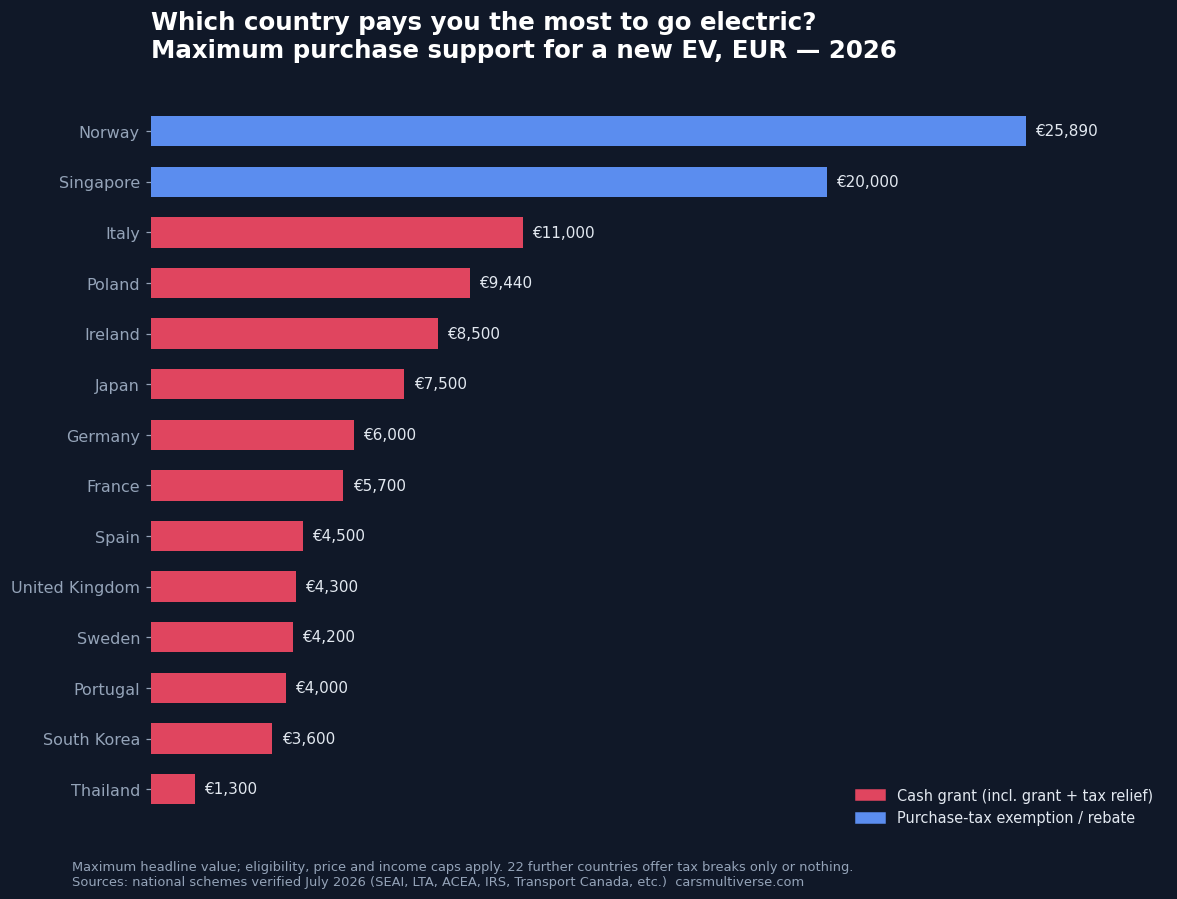
The 2026 ranking: countries with meaningful purchase support
Maximum headline value of national purchase support (cash grants plus quantifiable purchase-tax rebates), converted to euros. Eligibility, income and price caps apply almost everywhere — see notes.
| # | Country | Max value | Type | Notes & eligibility |
|---|---|---|---|---|
| 1 | Norway | €25,890 | Tax exemption | Full VAT exemption on new BEVs (value shown for a premium car; scales with price) + purchase-tax exemption |
| 2 | Singapore | €20,000 | Tax rebate | Up to S$30,000 registration-fee (ARF) rebates in 2026: VES Band A1 45% + EEAI 45% (capped S$7,500); EEAI ends 31 Dec 2026 |
| 3 | Italy | €11,000 | Cash grant | Up to €11,000 – income- and scrappage-dependent; Europe’s biggest 2026 cash grant |
| 4 | Poland | €9,440 | Cash grant | PLN 40,000 ‘NaszEauto’ grant + excise-duty exemption |
| 5 | Ireland | €8,500 | Grant + tax relief | €3,500 SEAI grant + VRT relief up to €5,000 (price caps apply); separate €8,500 ICE2EV scrappage scheme launched July 2026 |
| 6 | Japan | €7,500 | Cash grant | CEV subsidy up to ¥1,300,000 since Jan 2026 – amount varies sharply by manufacturer scoring |
| 7 | Germany | €6,000 | Cash grant | €6,000 income-based grant, retroactive from 1 Jan 2026 |
| 8 | France | €5,700 | Cash grant | Up to €5,700 – scheme- and income-dependent |
| 9 | Spain | €4,500 | Cash grant | €4,500 (EU-manufactured EVs) + tax deductions |
| 10 | United Kingdom | €4,300 | Cash grant | Electric Car Grant £3,750 (Band 1) / £1,500 (Band 2), cars ≤£37,000; band depends on manufacturer sustainability criteria |
| 11 | Sweden | €4,200 | Cash grant | New elbilspremie (Mar 2026): SEK 46,800 over 36 months – rural municipalities & lower incomes only |
| 12 | Portugal | €4,000 | Cash grant | €4,000 grant + zero registration tax |
| 13 | South Korea | €3,600 | Cash grant | Up to ₩5.8M national (+₩1M trade-in bonus + local top-ups); price caps apply |
| 14 | Thailand | €1,300 | Cash grant | THB 50,000 under EV3.5 – locally assembled BEVs only (was THB 100,000 in 2025) |
Tax breaks only — no purchase grant
| Country | What you get instead |
|---|---|
| Denmark | BEVs pay only 40% of registration tax with big base deduction – most mainstream BEVs pay little or none |
| Netherlands | 30% motor-tax discount 2026–2028; purchase subsidy ended after 2024 |
| Finland | Zero car tax (autovero) on BEVs; purchase subsidy ended 2023; annual tax rising from 2026 |
| Austria | Registration-tax (NoVA) exemption; €5,000 federal grant ended Feb 2025; regional schemes remain |
| Belgium | Registration/ownership tax reductions (region-dependent); no purchase grant |
| Turkey | Much lower ÖTV excise band for BEVs (25–75% vs 90–220% for petrol) |
| India | 5% GST on EVs vs ~28%+ for petrol cars; national subsidy covers two/three-wheelers only |
| Malaysia | Locally assembled BEVs free of excise duty and sales tax until end-2027; import exemptions ended 2025 |
| Indonesia | Government covers 40–100% of VAT on BEV cars from June 2026 (capped programme) |
| Philippines | Zero excise tax + zero import tariff on BEVs until 2028 |
| Australia | FBT exemption for BEVs (via salary packaging) – no direct rebate |
| Mexico | New-vehicle tax (ISAN) exemption; no cash grant |
| Brazil | Reduced IPI under MOVER; import-duty holiday fully phased out – 35% from July 2026 |
| United Arab Emirates | Emirate-level perks (Dubai: registration fees, Salik, parking); no national grant |
No national support at all
| Country | Status in 2026 |
|---|---|
| United States | Federal $7,500 credit ended 30 Sep 2025; state programmes vary |
| Canada | iZEV paused Jan 2025, formally ended Oct 2025; successor undecided; provincial rebates in QC/BC |
| New Zealand | Clean Car Discount scrapped end-2023; Budget 2026 confirmed no replacement; EVs now pay road-user charges |
| Hong Kong | FRT concession for private EVs EXPIRED 31 March 2026 and was not extended |
| Switzerland | No federal support; 4% import duty applies since 2024; canton-level tax breaks only |
| Saudi Arabia | No purchase incentive; support is supply-side (manufacturing, charging) |
| Qatar | No purchase incentive; focus on charging infrastructure |
| South Africa | No consumer incentive – EVs face HIGHER import duty (25%) than petrol cars (18%) |
Download the full dataset (CSV) — free to reuse with attribution to CarsMultiverse.
What it means for buyers
Incentives now change faster than model years: four of the schemes above changed materially in the last 12 months alone. If you live in a grant country, check the budget status before you order — Italy’s and Poland’s schemes are budget-capped, Germany’s is income-based, and Singapore’s rebate halves after 2026. If you live in a zero-support country, the case for going electric rests on running costs — which, as our companion study shows, still favour EVs in all 36 countries we analysed.
Methodology
We compared national-level purchase support for a private buyer of a new battery-electric car, as in force in July 2026. The ranking value is the maximum headline amount of cash grants plus quantifiable one-off purchase-tax rebates (VAT, registration or acquisition tax); recurring benefits (annual road tax, company-car tax, tolls, parking) and sub-national programmes (US states, Canadian provinces, Swiss cantons, German Länder, Korean municipalities) are noted but not counted. Currency conversions are approximate at July 2026 rates. Norway’s VAT-exemption value scales with car price; the figure shown reflects a premium model. Schemes open and close mid-year — always confirm on the official national portal, and see our continuously updated EV incentives tracker.
Key sources: SEAI (Ireland), LTA Singapore, ACEA 2026 tax–benefit tables, IRS (US), Transport Canada, Naturvårdsverket (Sweden), HK Government Gazette (Feb 2026), national scheme portals and 2026 trade press (electrive, Euronews) — each scheme verified against a dated source in July 2026.
FAQ
Which country has the biggest EV grant in 2026?
Italy — up to €11,000 off a new electric car, subject to income and scrappage conditions. Counting tax forgiveness, Norway’s VAT exemption is worth even more (up to ≈€25,900 on a premium car).
Does the US still have a federal EV tax credit?
No. The $7,500 federal clean-vehicle credit ended for vehicles acquired after 30 September 2025. Some state-level rebates remain.
Does the UK have an EV grant in 2026?
Yes — the Electric Car Grant gives £3,750 (Band 1) or £1,500 (Band 2) off eligible new EVs priced under £37,000, applied at the point of sale.
Can I reuse this data?
Yes — the chart and CSV are free to republish with a link to this page. For questions about the data, contact us.