Original research by CarsMultiverse · Q3 2026 edition · Published 17 July 2026 · Updated quarterly
Charging an electric car at home costs $0.54 per 100 km in Qatar and $7.57 in Ireland — a 14× gap between the cheapest and most expensive of the 36 countries in our quarterly index. Filling a typical 60 kWh battery at home ranges from under $2 (Qatar, Malaysia) to almost $27 (Ireland). This is the Q3 2026 edition of the CarsMultiverse Home EV Charging Price Index; we refresh it every quarter as electricity prices move.
Key findings — Q3 2026
- Cheapest home charging on Earth: Qatar ($0.54 per 100 km), Malaysia ($0.83) and Saudi Arabia ($0.88) — subsidised electricity makes EV running costs almost negligible.
- Most expensive: Ireland ($7.57 per 100 km), Italy ($7.09) and Belgium ($6.87) — yet even there, petrol costs roughly double per kilometre.
- The 14× spread between cheapest and most expensive is wider than the petrol-price spread across the same countries (about 7× excluding Hong Kong) — where you live matters more for EVs than for petrol cars.
- A full 60 kWh charge costs under $8 in 14 of 36 countries, and over $20 in only four (Ireland, Italy, Germany, Belgium).
- Annual charging bill (15,000 km): from $81 in Qatar to $1,135 in Ireland — against typical annual petrol bills of $700–$2,600 across the same markets.
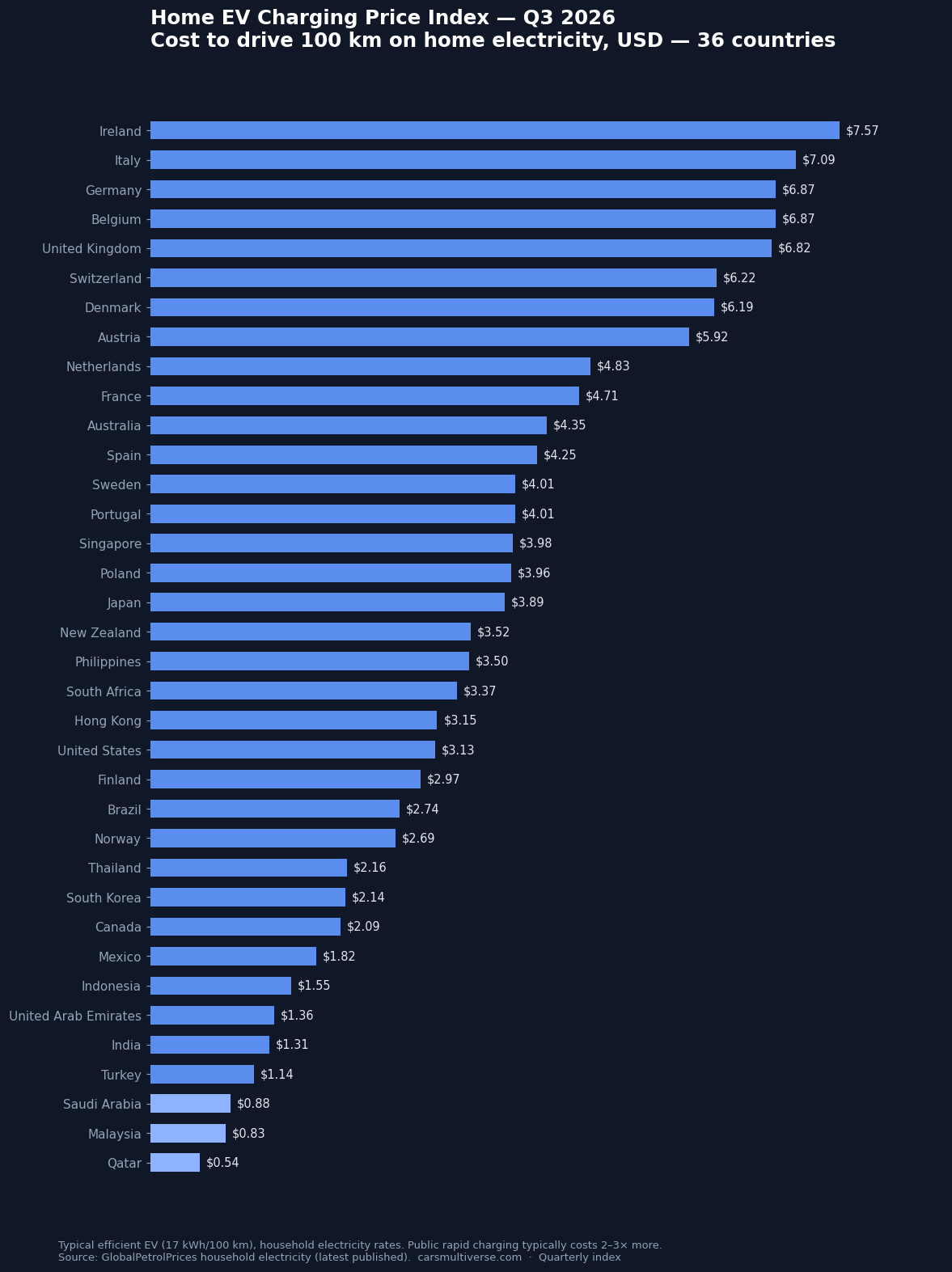
The full index — all 36 countries
Ranked cheapest to most expensive. All figures USD, based on the latest published household electricity prices and a typical efficient EV (17 kWh/100 km, home charging).
| # | Country | Electricity /kWh | Cost / 100 km | Full charge (60 kWh) | Charging / year |
|---|---|---|---|---|---|
| 1 | Qatar | $0.032 | $0.54 | $1.92 | $82 |
| 2 | Malaysia | $0.049 | $0.83 | $2.94 | $125 |
| 3 | Saudi Arabia | $0.052 | $0.88 | $3.12 | $133 |
| 4 | Turkey | $0.067 | $1.14 | $4.02 | $171 |
| 5 | India | $0.077 | $1.31 | $4.62 | $196 |
| 6 | United Arab Emirates | $0.080 | $1.36 | $4.80 | $204 |
| 7 | Indonesia | $0.091 | $1.55 | $5.46 | $232 |
| 8 | Mexico | $0.107 | $1.82 | $6.42 | $273 |
| 9 | Canada | $0.123 | $2.09 | $7.38 | $314 |
| 10 | South Korea | $0.126 | $2.14 | $7.56 | $321 |
| 11 | Thailand | $0.127 | $2.16 | $7.62 | $324 |
| 12 | Norway | $0.158 | $2.69 | $9.48 | $403 |
| 13 | Brazil | $0.161 | $2.74 | $9.66 | $411 |
| 14 | Finland | $0.175 | $2.97 | $10.50 | $446 |
| 15 | United States | $0.184 | $3.13 | $11.04 | $469 |
| 16 | Hong Kong | $0.185 | $3.15 | $11.10 | $472 |
| 17 | South Africa | $0.198 | $3.37 | $11.88 | $505 |
| 18 | Philippines | $0.206 | $3.50 | $12.36 | $525 |
| 19 | New Zealand | $0.207 | $3.52 | $12.42 | $528 |
| 20 | Japan | $0.229 | $3.89 | $13.74 | $584 |
| 21 | Poland | $0.233 | $3.96 | $13.98 | $594 |
| 22 | Singapore | $0.234 | $3.98 | $14.04 | $597 |
| 23 | Sweden | $0.236 | $4.01 | $14.16 | $602 |
| 24 | Portugal | $0.236 | $4.01 | $14.16 | $602 |
| 25 | Spain | $0.250 | $4.25 | $15.00 | $638 |
| 26 | Australia | $0.256 | $4.35 | $15.36 | $653 |
| 27 | France | $0.277 | $4.71 | $16.62 | $706 |
| 28 | Netherlands | $0.284 | $4.83 | $17.04 | $724 |
| 29 | Austria | $0.348 | $5.92 | $20.88 | $887 |
| 30 | Denmark | $0.364 | $6.19 | $21.84 | $928 |
| 31 | Switzerland | $0.366 | $6.22 | $21.96 | $933 |
| 32 | United Kingdom | $0.401 | $6.82 | $24.06 | $1,023 |
| 33 | Germany | $0.404 | $6.87 | $24.24 | $1,030 |
| 34 | Belgium | $0.404 | $6.87 | $24.24 | $1,030 |
| 35 | Italy | $0.417 | $7.09 | $25.02 | $1,063 |
| 36 | Ireland | $0.445 | $7.57 | $26.70 | $1,135 |
Download the full dataset (CSV) — free to reuse with attribution to CarsMultiverse.
What moved this quarter
This is the inaugural edition of the index, establishing the Q3 2026 baseline. From the next edition onward, this section will track which countries got cheaper or more expensive for EV drivers and why (tariff changes, subsidy reform, energy-market moves). Household electricity prices are annual averages and change more slowly than petrol prices — but when they move, they move the whole EV ownership case.
Home vs public charging
This index measures home charging, which is how most EV owners charge most of the time. Public AC charging typically costs 1.5–2× the home rate, and rapid DC charging 2–3× — in a high-price market like Germany or Ireland, relying entirely on rapid charging can approach petrol costs per kilometre. If you can’t charge at home, check our buying guide on whether an EV still fits, and see model-by-model charging costs on our country EV data pages for 14 markets.
Methodology
Cost per 100 km = household electricity price (USD/kWh, latest published national averages from GlobalPetrolPrices) × 17 kWh/100 km, the real-world consumption of a typical efficient compact EV including charging losses. Annual figure assumes 15,000 km. Time-of-use EV tariffs, where available, can cut these costs by 30–50% — our figures use standard household rates, so they are conservative for savvy owners. Index refreshed quarterly; companion studies: EV vs petrol savings by country and the global incentive ranking.
FAQ
Which country has the cheapest EV charging in the world?
Qatar — about $0.54 to drive 100 km on home electricity, followed by Malaysia ($0.83) and Saudi Arabia ($0.88), based on Q3 2026 household electricity prices.
Which country has the most expensive EV charging?
Of the 36 countries in our index: Ireland, at about $7.57 per 100 km ($0.445/kWh), followed by Italy and Belgium. Even there, charging at home is roughly half the per-km cost of petrol.
How much does it cost to fully charge an electric car?
For a typical 60 kWh battery at home: from under $2 in Qatar or Malaysia to about $27 in Ireland — $7–$15 in most major markets.
How often is this index updated?
Quarterly. This is the Q3 2026 baseline edition; each new edition tracks which countries became cheaper or more expensive and why.