Updated 19 July 2026 · Original research by CarsMultiverse · Data: national tax authorities, July 2026
Which country adds the most tax to a new car? Singapore, by an enormous margin: taxes and mandatory certificate costs add about €134,900 to a €30,000 petrol compact – 4.5× the price of the car itself – driven by the record Cat A COE of S$129,000 (July 2026). Denmark (132% of the car’s pre-tax price) and Turkey (128%) lead the rest of the world, while Qatar adds just ~€180 – no VAT, no purchase tax. Across our 36 countries, the government take on the same car spans a 750-fold range.
Key findings (July 2026)
- Singapore €134,882 (450%) – ARF + a record S$129,000 COE (8 Jul 2026) make it the world’s most expensive place to put a new car on the road.
- Denmark is Europe’s tax champion: €39,530 (132%) – its registration tax still reaches a 150% marginal rate; Turkey is just behind at €38,400 (128%), where the 90% ÖTV is charged before 20% VAT is applied on top.
- Five countries tax the car more than the car costs or nearly so: Singapore, Denmark, Turkey, Malaysia (92%) and Norway (77%).
- Japan abolished its purchase excise on 1 April 2026 – its one-off take is now just €199 in fees, among the world’s lowest for a rich country.
- The cheapest places to buy: Qatar (€180, 0.6%), UAE (€1,685), the United States (~€2,100 in a typical state) – under 7% of the car’s price.
- Electric cars dodge most of it in Europe – €0 registration tax in Norway, ~€0 in Denmark and Ireland, exemptions in Portugal, Spain, Poland and Germany – but Hong Kong’s EV concession expired on 31 March 2026, and EVs now pay the full 46–132% First Registration Tax there.
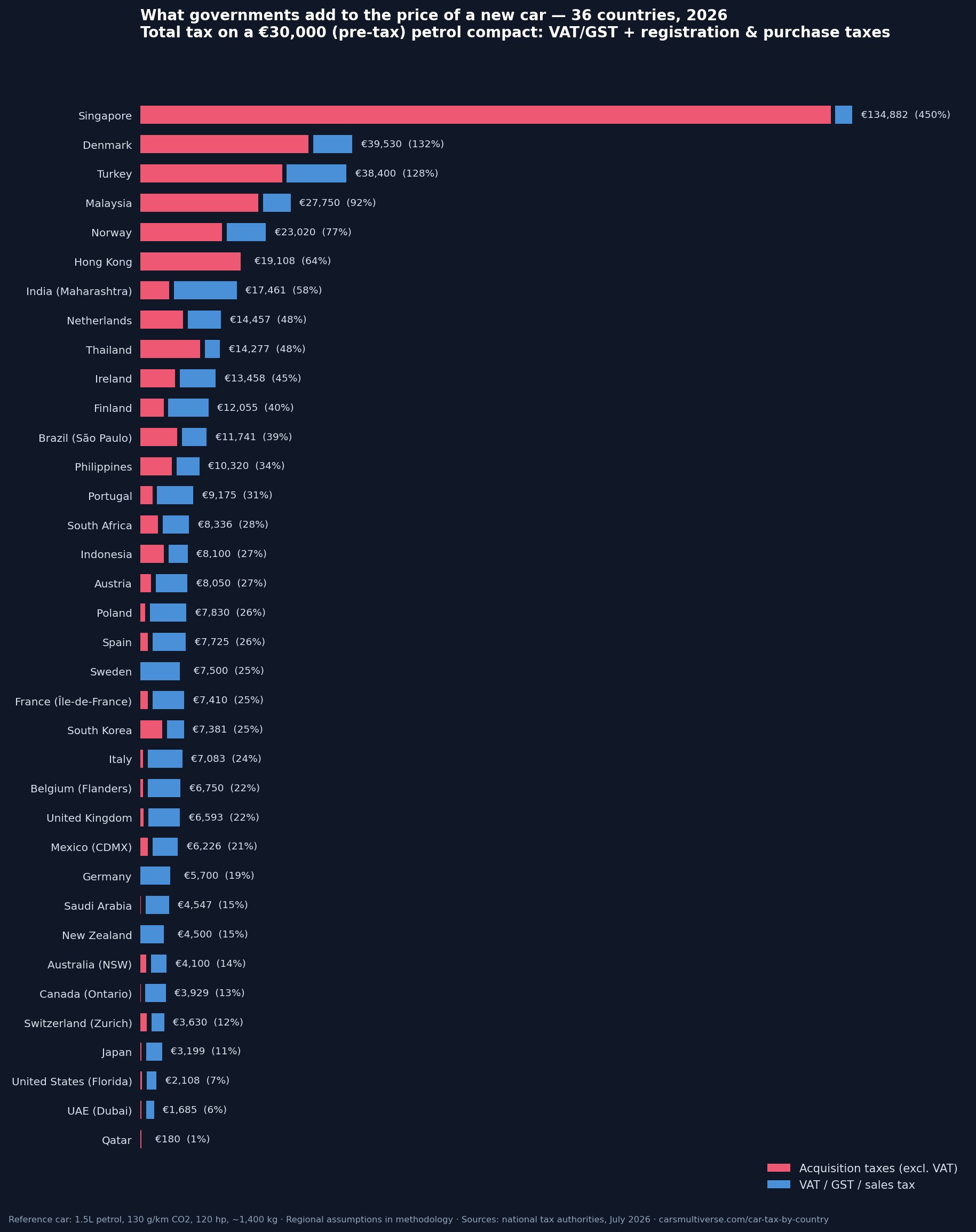
Which country taxes new cars the most? The full 36-country ranking
The table shows the total first-year government take – VAT/GST plus all registration, purchase and excise taxes – on the same reference car: a new petrol compact with a €30,000 pre-tax price, 1.5-litre engine, 130 g/km CO2 (WLTP), 120 hp, ~1,400 kg. Annual ownership tax is listed separately. Where taxes are regional, the region in brackets is used.
| # | Country | VAT/GST | Acquisition taxes (excl. VAT) | Total first-year take | % of pre-tax price | Annual ownership tax | EV one-off taxes (€) |
|---|---|---|---|---|---|---|---|
| 1 | Singapore | 9% GST | €131,642 | €134,882 | 449.6% | €462 | ~126,560 (EV ARF rebate) |
| 2 | Denmark | 25% | €32,030 | €39,530 | 131.8% | €204 | ~0 (EV deduction DKK 161,300) |
| 3 | Turkey | 20% KDV | €27,000 | €38,400 | 128.0% | €223 | ~7,500 (EV ÖTV 25%) |
| 4 | Malaysia | 10% sales tax | €22,500 | €27,750 | 92.5% | €19 | 0 CKD / ~3,000 CBU |
| 5 | Norway | 25% | €15,520 | €23,020 | 76.7% | €205 | 0 |
| 6 | Hong Kong | No VAT | €19,108 | €19,108 | 63.7% | €566 | 19,108 (concession expired 31 Mar 2026) |
| 7 | India (Maharashtra) | 40% GST | €5,460 | €17,461 | 58.2% | €0 | 0 road tax (EV GST 5%) |
| 8 | Netherlands | 21% | €8,157 | €14,457 | 48.2% | €820 | 687 flat BPM |
| 9 | Thailand | 7% | €11,380 | €14,277 | 47.6% | €43 | ~675 (BEV excise 2%) |
| 10 | Ireland | 23% | €6,558 | €13,458 | 44.9% | €200 | ~0 (relief to 31 Dec 2026) |
| 11 | Finland | 25.5% | €4,405 | €12,055 | 40.2% | €167 | 0 |
| 12 | Brazil (São Paulo) | 12% ICMS | €7,029 | €11,741 | 39.1% | €1,670 | ~same + 35% import tariff if imported |
| 13 | Philippines | 12% | €6,000 | €10,320 | 34.4% | €23 | 0 (EVIDA exemption) |
| 14 | Portugal | 23% | €2,275 | €9,175 | 30.6% | €148 | 0 |
| 15 | South Africa | 15% | €3,336 | €8,336 | 27.8% | €39 | ~3,064 (no CO2 levy) |
| 16 | Indonesia | 12% | €4,500 | €8,100 | 27.0% | €610 | 0 (BEV PPnBM 0%) |
| 17 | Austria | 20% | €2,050 | €8,050 | 26.8% | €536 | 0 NoVA |
| 18 | Poland | 23% | €930 | €7,830 | 26.1% | €0 | 0 |
| 19 | Spain | 21% | €1,425 | €7,725 | 25.8% | €59 | 0 |
| 20 | Sweden | 25% | €0 | €7,500 | 25.0% | €578 | 0 |
| 21 | France (Île-de-France) | 20% | €1,410 | €7,410 | 24.7% | €0 | ~414 carte grise |
| 22 | South Korea | 10% | €4,186 | €7,381 | 24.6% | €161 | ~1,276 (reliefs to 31 Dec 2026) |
| 23 | Italy | 22% | €483 | €7,083 | 23.6% | €227 | ~240–483 |
| 24 | Belgium (Flanders) | 21% | €450 | €6,750 | 22.5% | €300 | ~62 (new-2026 flat BIV) |
| 25 | United Kingdom | 20% | €593 | €6,593 | 22.0% | €233 | ~76 |
| 26 | Mexico (CDMX) | 16% IVA | €1,426 | €6,226 | 20.8% | €1,082 | 0 (ISAN-exempt) |
| 27 | Germany | 19% | €0 | €5,700 | 19.0% | €103 | 0 |
| 28 | Saudi Arabia | 15% | €47 | €4,547 | 15.2% | €25 | 47 |
| 29 | New Zealand | 15% GST | €0 | €4,500 | 15.0% | €88 | ~0 |
| 30 | Australia (NSW) | 10% GST | €1,100 | €4,100 | 13.7% | €282 | 1,100 |
| 31 | Canada (Ontario) | 13% HST | €29 | €3,929 | 13.1% | €0 | 29 |
| 32 | Switzerland (Zurich) | 8.1% | €1,200 | €3,630 | 12.1% | €290 | ~1,200 |
| 33 | Japan | 10% | €199 | €3,199 | 10.7% | €164 | 0 |
| 34 | United States (Florida) | ~7% sales | €264 | €2,108 | 7.0% | €40 | 264 |
| 35 | UAE (Dubai) | 5% | €185 | €1,685 | 5.6% | €95 | ~185 |
| 36 | Qatar | No VAT | €180 | €180 | 0.6% | €30 | ~180 |
⬇ Download the full dataset (CSV, free to reuse with attribution) – includes tax names, formulas, annual-tax bases, EV annual taxes and 2026 policy notes for all 36 countries.
What changed in car taxes in 2026?
2026 has been the busiest year for car-tax policy in a decade. The biggest shifts: Japan abolished its environmental performance excise on 1 April 2026; Hong Kong let its EV First Registration Tax concession expire on 31 March 2026; Thailand switched to CO2-based excise bands on 1 January 2026; South Korea’s consumption-tax cut lapsed on 1 July 2026, putting prices up overnight; Norway restructured its engangsavgift (CO2 taxed from the first gram) and now charges VAT on EVs above NOK 300,000; Germany extended its EV ownership-tax exemption to registrations through 2030; and Singapore’s Cat A COE hit a record S$129,000 in July 2026. Malaysia’s CBU-EV exemptions and Indonesia’s EV VAT incentive both expired on 31 December 2025.
How do electric cars change the picture?
In most of Europe, an EV still skips some or all acquisition tax – but 2026 is the year the free ride started ending. EVs pay €0 registration tax in Norway (though VAT now applies above NOK 300,000), effectively €0 in Denmark and Ireland, and are fully exempt in Portugal and Poland. But the Netherlands now charges EVs a flat €687 BPM, the UK charges EVs standard road tax, Hong Kong’s expired concession means EVs pay the full 46–132% FRT, and New Zealand charges EVs distance-based road-user charges that usually exceed what petrol drivers pay in annual fees. The EV columns in the table and CSV show the July-2026 position for every country.
Methodology
We computed every tax that applies to the first registration of the same reference car – a new petrol compact, €30,000 pre-tax price, 1,498cc, 130 g/km CO2 (WLTP), 88 kW / 120 hp, ~1,400 kg – in each of the 36 countries CarsMultiverse covers, using national tax-authority sources current to July 2026 (Skatteministeriet, Belastingdienst, Revenue.ie, HMRC/DVLA, finanz.at, Vero.fi, Skatteetaten, LTA/OneMotoring Singapore, GovHK, SAT Mexico, Revenue NSW, SARS, and others; full source list in the CSV). “Total first-year take” = VAT/GST as actually charged (including on top of excise where the law stacks them, as in Turkey and Denmark) + all one-off registration/purchase/excise taxes and mandatory fees. Annual ownership taxes are reported separately. Where taxes vary regionally we used a named region: Florida (US), Ontario, NSW, São Paulo, CDMX, Île-de-France, Flanders, Zurich, Maharashtra, Dubai, Madrid and Gauteng. Exchange rates: ECB reference rates, mid-July 2026. Figures are estimates for comparison; exact amounts vary with configuration, region and dealer fees. Singapore’s COE is a tradeable certificate rather than a tax in the narrow sense – we include it because it is a mandatory state-auctioned cost of registration.
FAQ
Which country has the highest tax on new cars in 2026?
Singapore. Registering a €30,000 petrol car costs about €134,900 in taxes and mandatory certificates – roughly 4.5 times the car’s own price – because of the Additional Registration Fee and the Certificate of Entitlement, which hit a record S$129,000 for Cat A cars in July 2026. Among countries without a quota system, Denmark (132% of the car’s pre-tax price) and Turkey (128%) are highest.
Which country has the lowest car taxes?
Qatar – it has no VAT and no purchase tax, so a new car attracts only about €180 in registration fees. Among large economies, the United States is lowest: roughly 7% in state sales tax plus small fees, and annual registration costs of only tens of euros in most states.
Why are cars so expensive in Denmark and Norway?
Both levy heavy one-off registration taxes on top of 25% VAT. Denmark’s registreringsafgift reaches a 150% marginal rate on the car’s value plus a CO2 surcharge – adding about €32,000 to our €30,000 reference car. Norway’s engangsavgift is weight- and CO2-based (about €15,500 for the same car) and was restructured in January 2026 to tax CO2 from the first gram.
Do electric cars pay registration tax in Europe in 2026?
Mostly little or none – €0 in Norway, effectively €0 in Denmark and Ireland (relief extended to 31 December 2026), and full exemptions in Portugal and Poland. But the exemptions are shrinking: the Netherlands charges EVs a flat €687 BPM, the UK applies standard road tax to EVs, and outside Europe Hong Kong’s EV concession expired on 31 March 2026.
Is VAT charged on top of other car taxes?
In several countries, yes – the taxes stack. Turkey charges 20% KDV on the price including the 90% ÖTV excise. Denmark computes its registration tax on the VAT-inclusive price. Finland’s autovero is a percentage of the VAT-inclusive retail value. This stacking is why total tax can exceed 100% of the car’s pre-tax price.
Explore more CarsMultiverse research
- Where an Electric Car Saves You the Most: 36-Country Ranking (2026)
- Which Country Pays You the Most to Go Electric? 2026 Global Incentive Ranking
- Home EV Charging Price Index – Q3 2026
- All original research →
Disclaimer & reuse: Figures are estimates compiled from the cited official and public sources for general information only – they are not tax, financial or legal advice; verify current rates with the official national sources before making decisions. Vehicle names and trademarks belong to their respective owners and are used for identification only. Our tables and CSV datasets are free to reuse with attribution to CarsMultiverse (CC BY 4.0). See our Terms of Service.